

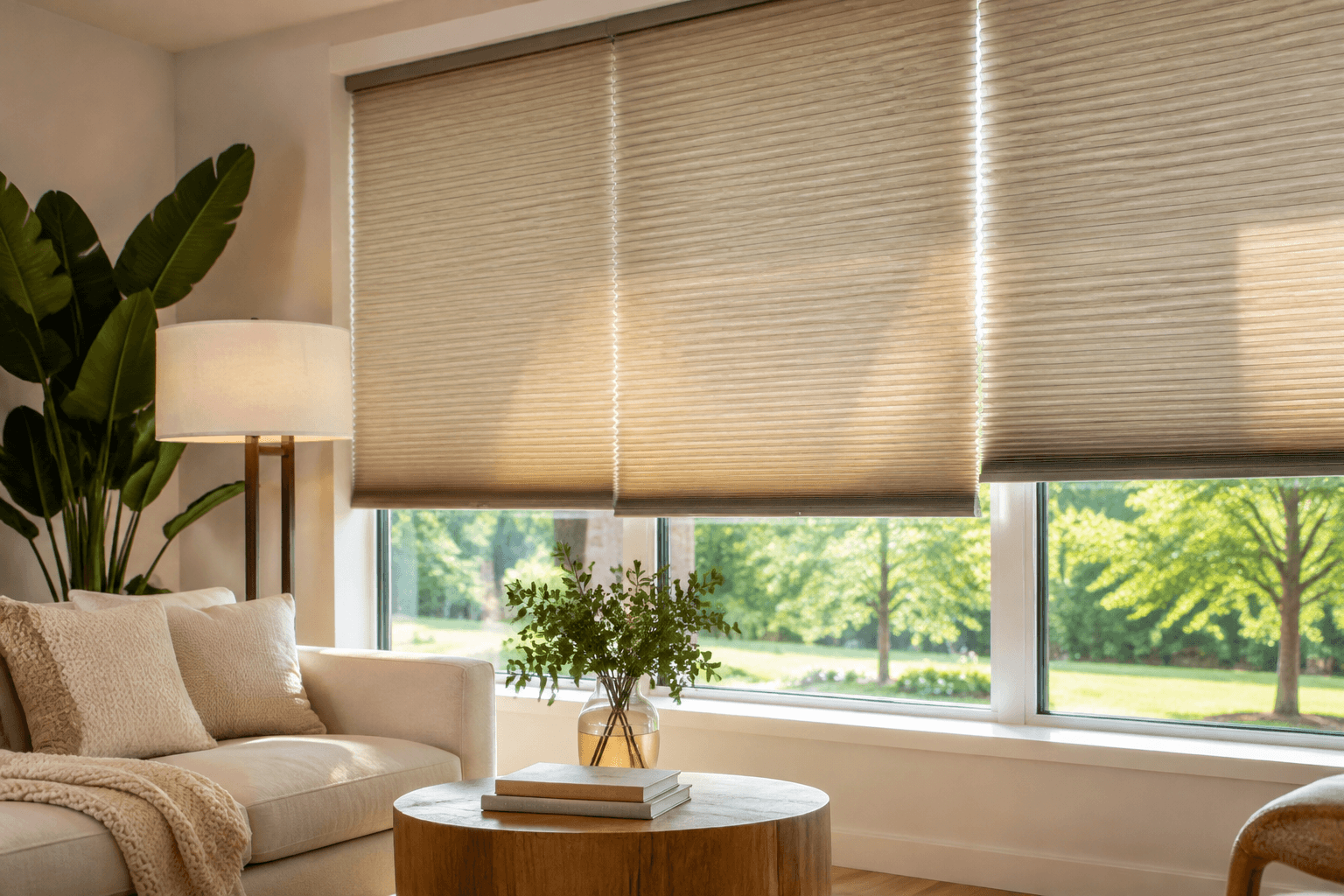
Quick answer: The most energy efficient window coverings for Huntsville are cellular shades, tightly fitted thermal drapes, and solar screens on sun-heavy glass, and the right pick depends mostly on which way the window faces. We are Bullish Blind Co, a Huntsville company that measures, builds, and installs window coverings for homes and businesses in Madison, Decatur, Athens, Florence, and across North Alabama. This guide covers what actually moves the needle on your cooling bill, where a cheaper option is good enough, and where it is not.
Why Window Coverings Affect Your Energy Bills
Glass is the weakest thermal point in most walls. In summer, sunlight passes through it and turns into heat inside the room. In winter, the glass becomes the coldest surface in the house and pulls warmth out of the room.
Two numbers describe this. The U-factor tells you how easily heat flows through the window, and lower is better. The solar heat gain coefficient (SHGC) tells you how much of the sun's energy gets through as heat, and lower is better in our climate. Both appear on the label that the National Fenestration Rating Council (NFRC) puts on rated windows. A covering does not change those labels, but it adds a second layer on top of them.
Our climate makes this matter. North Alabama has hot, humid summers and a long cooling season, so your air conditioner runs for months. Winters are mild, but we get cold snaps that push the heating system hard for a few days. A good covering helps in both seasons. It blocks solar heat in July and slows heat loss in January.
One honest caveat. The U.S. Department of Energy notes that shading works best when it stops the sun before it reaches the glass. An interior covering catches heat after it has already passed through, so it reduces gain rather than eliminating it. Exterior options and reflective backings do better on the hottest exposures. You can find more on window performance and ratings at ENERGY STAR.
The Most Energy Efficient Window Coverings
Here is how the main options compare. The cost ranges are rough installed prices per square meter of window in US dollars. Fabric, size, and motorization move them up or down.
| Type | Insulation value | Light control | Best window location | Typical cost range |
|---|---|---|---|---|
| Cellular shades | Highest of the group, better with double cells | Light filtering to blackout | Bedrooms, west and south windows, any room that needs both seasons covered | $90 to $250 per m² |
| Thermal drapes | Moderate to high when lined and hung close | Light filtering to blackout | Living rooms, large windows, sliding doors | $60 to $200 per m² |
| Insulated roller shades | Moderate | Sheer to blackout | Home offices, offices, clean modern spaces | $100 to $280 per m² |
| Solar screens | Low insulation, strong sun rejection | Reduces glare, keeps the view | West and south glass, sunrooms, storefronts | $40 to $120 per m² |
| Woven woods | Low | Filtering, rarely full blackout | Dining rooms, dens, spaces where looks come first | $90 to $220 per m² |
Cellular Shades
Cellular shades (also called honeycomb shades) are our usual first recommendation. Their folded cells trap a pocket of still air against the glass, and still air is a poor conductor of heat. Double-cell versions add a second pocket and perform better, though they cost more and stack a bit thicker when raised.
They do have limits. They are less forgiving in very damp spaces like a bathroom with poor ventilation, and a light-colored fabric facing the sun will still let some heat through. Pick a reflective or darker-backed fabric for the hottest windows.
Thermal Drapes
Thermal drapes can be excellent when they are done right and mediocre when they are not. A lined panel hung close to the wall, wide enough to overlap the frame, works as a real barrier. A thin curtain on a rod set high above a gap does very little. If you want an energy efficient drapes window covering that also looks good in a living room, spend the money on the lining and the width.
Solar Screens
Solar screens are a mesh that blocks a large share of the sun's energy while keeping your view. They are the cheaper option that is often good enough for a hot west-facing window that is not a bedroom. They do little for winter insulation, so think of them as a summer tool.
What Custom Window Coverings Help the Most With Energy Efficiency
Fit matters more than the material alone. A premium fabric with gaps around it can lose to an average fabric that seals well.
Air moves around the edges of a covering. Warm air on the room side meets cold or hot glass, sinks or rises, and circulates through any gap. These light gaps around the frame (the thin lines of daylight you can see at the sides and top) are also gaps where heat and air travel. Closing them is where custom work pays off.
That is why we measure to the millimeter. A good custom shade has these features:
- Exact width and drop: We usually keep the gap between the shade and the frame to a few millimeters.
- Side channels or tracks: These hold the edges of the shade close to the frame and stop air from slipping through.
- A proper headrail or valance: This closes the top, where warm air tends to escape.
- A tight inside mount or a generous outside mount: Which is better depends on how deep your window recess is.
Example scenario: Picture a house in West Huntsville with a west-facing wall of glass. By late afternoon in summer, that room runs several degrees hotter than the rest of the home, and the air conditioner struggles to catch up. A stock-size blind from a big box store typically leaves wide gaps at the sides and a loose top. A custom double-cell shade with side channels, in a reflective-backed fabric, would close those gaps and cut the solar load much more effectively. A solar screen outside would help further.
Energy Efficiency in Commercial Window Coverings
Commercial spaces feel the same physics at a larger scale. Big storefront glass, long south or west facades, and a cooling load that never really stops during our summers. Window coverings affect the HVAC load, but they also affect glare and tenant comfort, which are often what tenants complain about first.
- Offices: Glare on monitors is the common problem. Insulated roller shades or solar screens cut brightness while keeping daylight, which can reduce the need for artificial lighting and for blasting cold air at the hot side of the building.
- Clinics: Privacy matters as much as heat. Cellular shades or opaque roller shades handle both.
- Retail and restaurants: You want the view in and out, so solar screens are often the better fit. They keep the storefront bright while taking the edge off afternoon sun and protecting merchandise and furniture from fading.
Example scenario: Imagine a medical office in a strip center with a south-facing exposure. The front exam rooms run warm and bright in the afternoon, and staff keep adjusting blinds by hand, or forget to. Motorized shades on a schedule would solve that. They could lower on sunny exposures during the hottest hours and rise in the morning, with no one thinking about it. Motorization costs more upfront and needs power or a battery plan, so it makes the most sense on large or hard-to-reach windows.
Energy Efficient Window Coverings in Huntsville, AL
When people search for energy efficient window coverings in Huntsville, AL, they usually want a local answer, and local conditions shape it. Summer sun is intense, afternoons are long, and humidity is high. That affects material choices. Fabrics and finishes should handle moisture without sagging or staining, and cordless or motorized operation holds up better than cheap pull cords.
Exposure matters too. West and south glass take the worst heat. North windows get steady, softer light and need far less. East windows get strong morning sun that fades by midday, so a lighter covering often does the job.
Neighborhood rules can also come into play. Some HOAs in Madison, Huntsville, and Athens set limits on what shows from the street, such as the color or backing of coverings facing the front. If you live in or near a historic district in Huntsville, such as Twickenham or Old Town, check with your HOA or the local historic commission before changing exterior-facing elements. Interior coverings are usually simple, but it is worth a phone call.
We serve homes and businesses across North Alabama, including Decatur, Florence, and the communities in between. We come to you, measure on site, and install, which matters because the measurement drives the result.
How to Choose the Right Option for Your Windows
Start with the direction the window faces, then the room, then the budget.
By window direction
- West and south: These take the most heat. Use cellular shades with a reflective backing, lined thermal drapes, or exterior solar screens. This is where spending more makes sense.
- East: Lighter cellular shades or roller shades are usually enough.
- North: Heat gain is minor. Choose for looks and winter comfort, and save money here.
By room use
- Bedrooms: Blackout cellular shades give you darkness and insulation in one product.
- Living areas: Lined drapes over a lighter shade look good and perform well.
- Home offices: Insulated roller shades control glare without making the room dim.
- Kitchens and baths: Choose moisture-friendly materials and skip heavy fabrics.
By budget: Put your money on the hottest windows first. A solar screen on a west window is a cheaper option that often does the job, while woven woods are better chosen for appearance than for performance. Do not feel you need to upgrade every window in the house at once.
If you want help sorting it out, we offer a free measurement and consultation. We will look at your windows, tell you which ones are worth the investment and which are not, and give you a clear quote with no pressure.